

Gold became 125% more expensive, but production has barely risen
In most markets, price and production are linked. Is oil getting more expensive? Then it pays to drill more. Is the copper price rising? Then projects that weren't viable before suddenly become interesting. Producers invest, production rises, and eventually more supply reaches the market.
With gold, you'd expect exactly the same. At the start of 2023, a troy ounce of gold cost around $1,835. The price is now around $4,140. That means the gold price has risen by roughly 125 percent in less than four years.
You'd think gold mines would respond en masse. But that's hardly happening.
In 2024, global gold production was around 3,645 metric tons. A year later, only a few percent was added. And in the first half of 2026, production rose by just 3 percent compared with a year earlier.
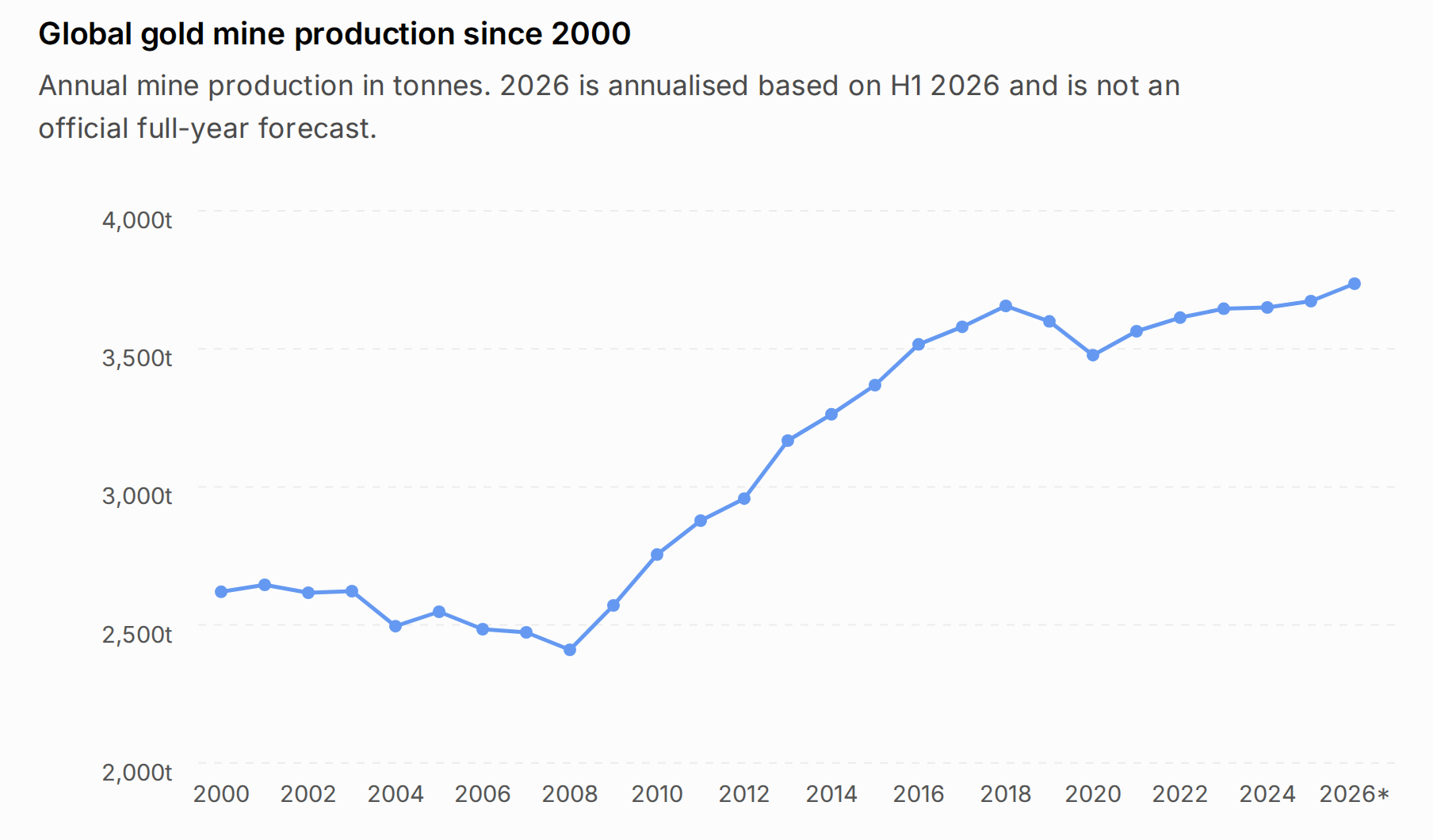
In the chart above, we can see that gold production rose quite strongly until around 2018. From roughly 2,620 metric tons in 2000 to 3,650 metric tons in 2018, an increase of nearly 40 percent. Since then, though, there has been barely any growth. For 2025, for example, the World Gold Council reported 3,672 metric tons. That's practically a standstill over seven years.
The gold price has therefore risen sharply in recent years, while the world is producing barely any more gold than in 2018.
Why aren't gold mines increasing production?
The main reason is that a gold mine isn't a factory where you can simply speed up the production line. Before gold comes out of the ground anywhere, a lot has to happen.
First, a gold deposit has to be found that is large and rich enough to be mined profitably. Not every place where gold is found is automatically suitable for a mine. There has to be enough gold present. The concentration has to be high enough, and the extraction costs have to stay low enough.
Then a decision has to be made on how the mine will be built and what infrastructure is needed. After that, the trickiest part often begins: permits.
According to the World Gold Council, 10 to 20 years can pass between the discovery of a gold deposit and actual production. Moreover, only a very small share of all the sites explored eventually grows into a producing mine.
A gold price of $4,000 can therefore suddenly make a new project financially attractive. But that doesn't mean the mine will exist tomorrow. It can take ten years or longer.
On top of that, the 10-year yield on the US bond market is currently well above 5 percent. Financing for projects like these is therefore not attractive at the moment either. And a 10-year horizon already brings a lot of uncertainty with it.
Gold supply barely responds to price
That brings us back to this interesting development. A gold price that rises by more than 100 percent should normally trigger an explosion of new supply. But with gold, that mechanism works extremely slowly.
In the second quarter of 2026, global mine production rose by just 2 percent year over year, to around 966 metric tons. Even with record prices, growth remains limited.
It's of course not the case that a higher gold price has no effect at all. Mines become more profitable as a result. Companies invest more. Projects that weren't interesting before can still be developed.
But that supply arrives with an enormous delay. That's also why existing gold mines have suddenly become so valuable. Last week, Gold Fields made a takeover bid of more than $27 billion for its Australian gold mining rival Northern Star. That bid was rejected.
This unusual relationship between price and production makes gold a unique asset.
The gold price has risen 125% since 2023, yet global gold production is barely growing. Why do gold mines respond so slowly to higher prices?

Thom Derks writes for GoldRepublic on gold, macro-economics and geopolitics. He studied Law in Leiden and Economics in Amsterdam. His personal fascination with scarcity and store of value through both bitcoin and gold brought him into the world of financial journalism. Through his own newsletter De Geldpers on Substack, he reaches over 5,800 subscribers with analyses on markets, geopolitics and the monetary system.